Friday, 4 October 2013
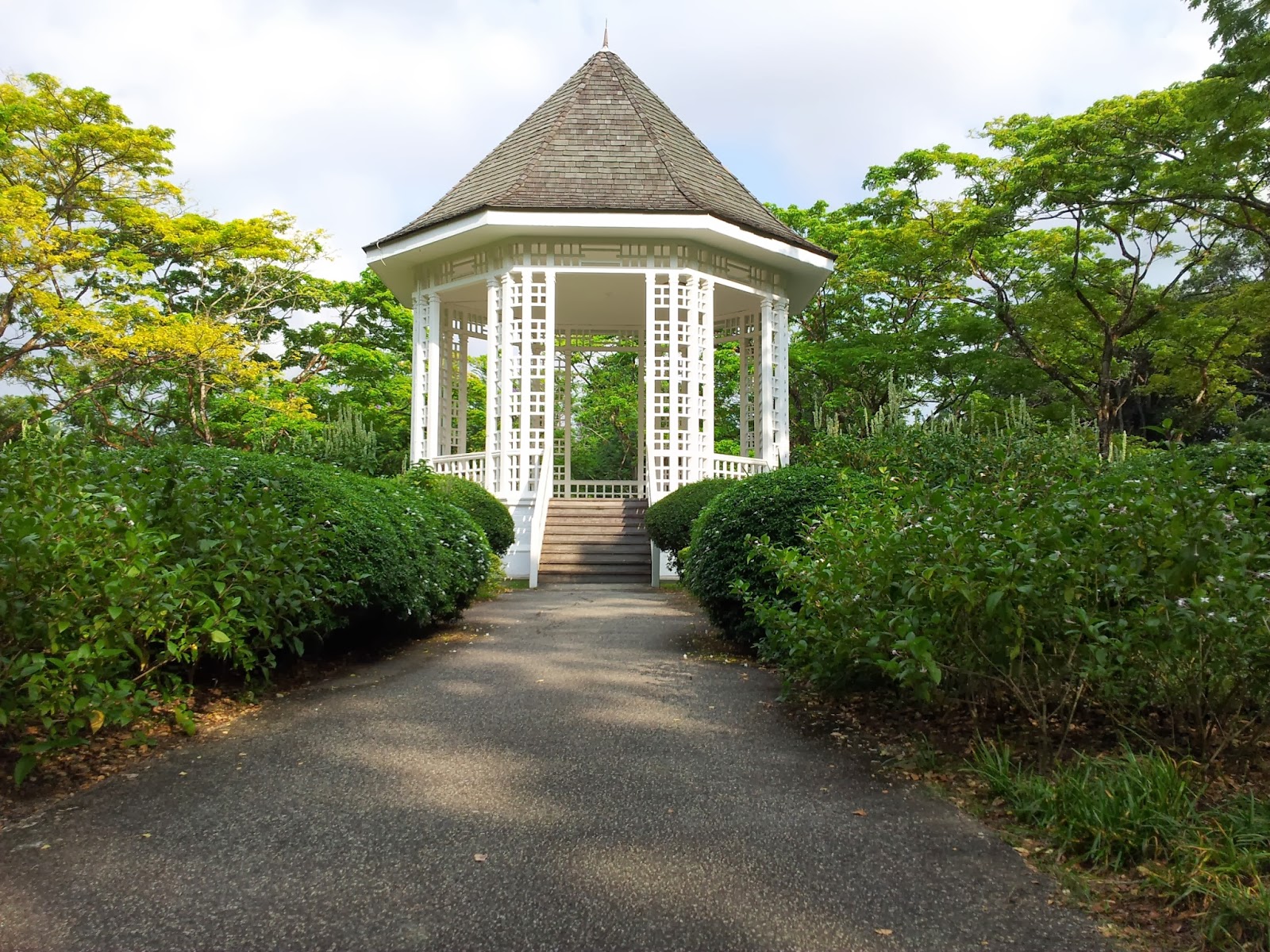
Iconic structure- Singapore
This iconic resting tent is probably the most recognized structure in the Singapore Botanical Garden. Many Singaporean student would had been brought to the Singapore Botanical Garden during their school's excursion. The tent is not only well known to visitors, but many couples as well. Some of us may have seen couples taking their wedding photograph at this very spot. The architectue of this resting tent reminds me of structures in Europe, complemented by the gothic feel. Indeed if by looking at only this tent with little revelation of its surrounding, it looks foreign. This probably explains why couples choose to take their wedding photographs here and also the popularity of this tent. But nowadays even this tent seems to be a thing of the past, maybe it will be forgotten one day :(


Architecture-18/19th century vs now
19th century architecture was greatly influenced by the earlier architectural movement and foreign, exotic styles. Revivals of Greek, Gothic , Renaissance designs were combined with conteporary engineering method and materials. These are the main type of architectural styles in the 19th century. The act of revival and use of historical, architectural forms or details is known as historicization. Historicization stimulate national nostalgia. Contemporary archietecture emphasize more on the function than the visual aspects of the structure. This also resulted in the simplification of form and absense of applied decorations. Some characteristic of contemporary architecture are materials 90 degrees to each other, simplicity and elimination of unnecessary details. As you can see in the pictures reference, the gothic style building has alot more details and decorations added. While in comparison to a contemporary building, a contemporary will look more simple and rectangular. There is almost no similarity between this two structure, visually. Personally I would prefer the 19th century architectural styles because of the uniqueness of the shape and form of the structure and the detailed craftmanship of the decorations. By reducing and removing the ''unnecessary details'', contemporary architecture seems to be very restricted and may not differ much from other contemporary architecture structure.


Types of painting styles
I am going to talk about the painting aspect of fine art. There many different styles of painting, some include realism, expressionism, pop art and abstract. I will be going into on realism , expressionism and abstract painting styles. Expressionism is a type of artform where the artist tries to covey his feeling through the painting. Edvard Munch is one of the pioneers in expressionism painting. Edvard Munch (1863-1944) is best known for his image of anxiety, isolation, rejection and other negative emotions which reflected his tragic life. Edvard Munch's most famous painting is known as ''The Scream''(1893), which he painted serveral versions. The paintings show an agonized figure against a tumultuous orange sky. Realism in painting means to exclude artistic conventions, implausible, exotic and supernatural elements. In another words, to represent subject matter truthfully. In the 20th century different genres of realism emerged, one of which is known as hyperrealism. Hyperrealism is a term to describe the extreme form of realistic paintings. Gottfried Helnwein is well know for his hyper-realistic painting of human portraits. Although realism avoids the use of artistic conventions or supernatuural elements, it could also be expressive for portrait painting. Abstract painting, a total opposite style of panting from realism. Abstract paintings are painted without a recognisable subject. Similar to expressionism painting, there is abstract expressionism which is to paint something that are not visual such as sound, emotions and spiritual experience. Pablo Picasso is one of the founder of modern abstract art. His works are also expressive to a certain extent as well. A learning point is that all painting can be expressive, its not only expressionism is expressive. Ultimately it depends on your execution and art is not about your skill but your content.


Local Talent
Ivan Hoo,a local artist who lives and breathes art.Ivan has been constantly drawing since at young age.As an artist,his style focusing more on Photo-realism , portraiture and figurative drawings with dry mediums such as charcoal,graphite,pastel,pencil in his artwork.
Among his achievement ,Ivan had his first exhibition at the 50 x 50 Square Invasion Painting Show 2011 and sold one of the painting.The show which is held at the Intinc Artspace Singapore is a collaboration with other local and international Artists.Today,he has taught Drawings And Paintings at Art Speaks Studio a local art space located in Singapore.
Although some may argued that photorealism are not art because it is basically copying what you see, but it is no doubt that in the 21st century art revolves around mainly realism.

Among his achievement ,Ivan had his first exhibition at the 50 x 50 Square Invasion Painting Show 2011 and sold one of the painting.The show which is held at the Intinc Artspace Singapore is a collaboration with other local and international Artists.Today,he has taught Drawings And Paintings at Art Speaks Studio a local art space located in Singapore.
Although some may argued that photorealism are not art because it is basically copying what you see, but it is no doubt that in the 21st century art revolves around mainly realism.

a true master of irezumi- Master Horiyoshi the third
At Horiyoshi's studio in Yokohama, Japan, tattoos are outlined freehand using an electric needle. He did the outlining by hand until the late 1990s. His friendship with Don Ed Hardy, started in the mid-1980s, lead to Horiyoshi's adoption of electric machines.Shading and color is added using the traditional tebori, or Japanese hand tattooing, technique. He restricts his motifs to the classical repertoire of the vast variety of traditional Japanese stories and designs: peonies, koi, dragons, tenyo (she-angels), etc. Horiyoshi feels responsible for keeping the classic repertoire alive, "one prick at a time."
Horiyoshi III's work can cost tens of thousands of dollars, and may require weekly hour-long visits over the course of several years to complete. His work is now limited to finishing existing clients' tattoos. According to Horiyoshi, he was inspired by a Yakuza (Japanese gangster) with a full-body tattoo in a public bathhouse when he was a young boy, "about eleven or twelve.

Horiyoshi III's work can cost tens of thousands of dollars, and may require weekly hour-long visits over the course of several years to complete. His work is now limited to finishing existing clients' tattoos. According to Horiyoshi, he was inspired by a Yakuza (Japanese gangster) with a full-body tattoo in a public bathhouse when he was a young boy, "about eleven or twelve.

Game Design
Game design refers to the central theme or point, as well as the story and plot and the characters' back-stories. In smaller games and in games in which there are no significant characters or plot (for example, in a racing game), game design refers to how one plays the game. What are the rules? How is the game scored? How does the level of difficulty change with play? What makes the game fun or challenging? Many would have thought that if they like to play game, they will be a good designer. WRONG! A good game designer usually has unbridled enthusiasm for new ideas, which she will stand behind no matter who bats them down. Unlike producers, who must be highly practical and willing to negotiate at every turn, a game designer needs an ounce or two of what some would call tenacity and other would call stubbornness. Designing games is one of those jobs where it actually helps to have a little bit of an ego, as a big part of it is convincing others that your ideas are spot on. Different designers are responsible for different part of the game, from game dialogue to character design.


Hyperrealism
Diego Fazio, a 22-year-old artist in Italy who also goes by DiegoKoi online, is known for his “precise lines and Oriental techniques,” according to his DeviantArt page. But just how precise and technical his work can be is best exemplified by how realistic his drawings appear.

One might be tempted to argue and say the above image is photograph, but Fazio created it entirely with pencil. Here’s the piece, which would be considered photorealistic, while still in the works.

According to DeviantArt, Diego was first a tattoo artist but eventually left to focus on drawing bodies. Instead of drawing on them, the artist uses hundreds of shades to create contrast and reproduce photo/hyper realistic work.

One might be tempted to argue and say the above image is photograph, but Fazio created it entirely with pencil. Here’s the piece, which would be considered photorealistic, while still in the works.

According to DeviantArt, Diego was first a tattoo artist but eventually left to focus on drawing bodies. Instead of drawing on them, the artist uses hundreds of shades to create contrast and reproduce photo/hyper realistic work.
Subscribe to:
Posts (Atom)